
Publications · 14 March 2016
In Search of Belarusian Hrodna
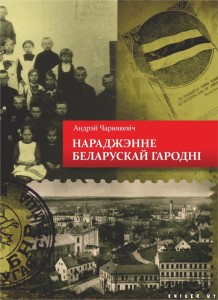 Charniakevich, Andrei (2015). The Birth of Belarusian Hrodna. Minsk: A.M. Yanushkevich Publishing House, 172 pp.
Review prepared by Andrei Vashkevich
Hrodna plays a rather ambiguous role in Belarusian national discourse. A city that, in the late nineteenth and early twenty-first centuries, was at least in terms of national composition one of the most “non-Belarusian” cities in our country (in 2009 Belarusians made up 62% of its inhabitants (Population of Hrodna…)), has long earned the honorary title of the “second capital of the Belarusian People’s Republic” and one of the “cradles” of modern Belarusian political nationalism. Yet despite this, references to the Belarusian movement in Hrodna are extremely scarce in scholarly literature. The most prolific researcher of Belarusian Hrodna is Candidate of Historical Sciences Andrei Charniakevich. The book under review is a continuation and, to some extent, a logical completion of the studies he began at the end of the twentieth century (Charniakevich, 1999; Charniakevich, 2003; Charniakevich, 2014).
The book covers the period from the beginning of the twentieth century to the Second World War, although some storylines, for example those devoted to Ryhor Shyrma or Branislau Rzheuski, concern the post-war years. A thoughtful and knowledgeable reader will find nothing “provocative” or “intriguing” in its pages.
Almost the whole of Andrei Charniakevich’s book is a chronicle of a difficult, selfless, and often hopeless struggle for the creation of independent Belarusian statehood, for the rights of the Belarusian language and Belarusian culture. Yet this, in our view, is the main strength of the study. The Belarusian movement is shown here not as a series of heroic acts, but as strenuous work in which the decisive role was played not by front-line politicians but by ordinary workers: teachers, actors, publishers, educators, people almost forgotten today.
It would be poorly grounded to reproach the author by saying that Belarusian Hrodna in fact existed from the tenth century and could not possibly have been “born” a hundred years ago together with the first Hrodna circle of Belarusian youth (Veras, 2013). At the beginning of the preface, Charniakevich states clearly: “Belarusianness in Hrodna at the level of ethnic features was always a natural phenomenon” (p. 6), but it is quite clear that the book deals with the formation of modern Belarusian nationalism (Hobsbawm, 1990). More than that, the author is interested not so much in the global processes of “nationalising” the broad masses of the Belarusian population as in the way individual people came to the Belarusian cause and how this was reflected in their personal destinies.
Looking closely at the individual person, whether the prime minister of the Belarusian People’s Republic or an ordinary activist of the Belarusian School Society, the author tries to answer for himself the question of what pushed fairly successful people onto the unpromising and often dangerous path of struggle for Belarusian statehood. He presents the motivation for his search in an interesting way: “I know today’s Belarusian Hrodna, its public and political figures. And this pushed me to look into the past, to search for the roots of our events, including our problems.”
The book consists of nine chapters and is structured according to a thematic-chronological principle. Chapter I is simply titled “First Steps.” Its central topic is the Hrodna circle of Belarusian youth, which existed from 1909 to 1913. It also mentions the events of the First World War, significant for the entire Belarusian movement at least because it was after the German occupation of the city that the first Belarusian school appeared here, in spring 1916.
The second chapter, “A Shelter for Exiles,” is devoted to the stay in Hrodna of the government of the Belarusian People’s Republic headed by Anton Luckievich. This short but very important period, from the end of 1918 to spring 1919, formed the most enduring part of what is considered Belarusian Hrodna, since at that time the city’s surroundings were the last piece of Belarusian land where the institutions of the BPR remained for a while.
We will not draw direct parallels between Hrodna and Vilnius or Lviv in those months, but we will note that, like those cities, Hrodna became an arena of struggle among several national projects: Belarusian, Polish, and Lithuanian. An important point stressed by the author is that although the Polish project ultimately won and Hrodna became part of the Polish state for two decades, this victory resulted from very active assistance from outside. Local Poles were never able to take power in the city on their own. In essence, the next section, “The First Belarusian Regiment,” is a continuation of this chapter.
The following six chapters cover a very short period: less than twenty years. The author discusses the most varied directions in the development of the Belarusian cause, from armed struggle in the ranks of the anti-Polish Belarusian-Lithuanian partisans, in which the Belarusian Socialist Revolutionaries were heavily involved, to cultural work in the Association of Belarusian Youth and the Belarusian Theatre under the Belarusian School Society. In the context of studying the cultural aspects of the Belarusian national movement, the sixth chapter of the book, “The Belarusian Cultural Project,” is especially interesting. Reading it leads to the conclusion that one of the greatest problems in the development of the Belarusian national movement in the first half of the twentieth century was the clear dominance of political rhetoric over cultural rhetoric.
Especially from the mid-1920s onward, Belarusian culture was perceived mostly as a means of promoting class values and radicalising the Belarusian masses in a pro-Soviet direction. Over time this led to grotesque metamorphoses of such formerly authoritative and influential organisations as the BSS, and to their rapid decline. Local Belarusian activists not only in Hrodna but also in nearby towns and villages found themselves in an especially difficult position. Any manifestation of their cultural work began to be perceived by the Polish authorities exclusively as political propaganda, while Polish administrative authorities often saw only what it was convenient for them to see.
Andrei Charniakevich leaves readers with an open question: what, after all, is the mythical Belarusianness of the city on the Neman? The Belarusian language can be heard much more easily in Maladziečna or Baranavichy, and today Mahiliou and Viciebsk have long surpassed Hrodna in the number of projects implemented during the years of independence to reconstruct cultural and national heritage.
As it seems to the author of this review, the answer lies, strangely enough, in Hrodna’s multinational character. In the environment of a large city which, although very modestly, nevertheless managed to preserve through the twentieth century an uninterrupted tradition of urban culture (something that cannot be said of every city in our country), Belarusians began to construct their identity more quickly than in places with a less diverse national composition. Yet here too the development of the Belarusian movement had its own specific features, well formulated by the author: “Belarusianness in Hrodna arose not as a sum of objective qualities, but rather as a form of consolidated nonconformism, as a rejection of the existing national projects. This was true for those individuals who became the avant-garde and took upon themselves the duty of forming this identity. The rejection itself had a double character. They not only opposed their opponents in political struggle. Above all, they went beyond the boundaries of the peasant community, where the national idea in its modern form could not objectively arise” (p. 59).
Belarusian activists, unsupported by the financial and other resources of townspeople and entrepreneurs, among whom there were almost no Belarusians, found themselves in a constant closed circle of attempts to return to the village and nationalise it. But doing this in the modern Polish state, and even more so in the USSR, where the “national” was perceived only as a form of the “socialist,” was extremely difficult, almost impossible. All the more so because throughout the twentieth century Belarusian activists remained “in the sights” of every authority and were quite actively destroyed.
The author does not address events connected with the Belarusian movement in Hrodna in the last decade of the twentieth and the beginning of the twenty-first centuries, saying only that they are “full of drama and contradictions” (p. ). But from the entire preceding context of the book it follows that the author sees them too as part of the still continuing process of the “birth of Belarusian Hrodna.”
The author of this review fully shares this hidden thought of the book’s author, despite almost a quarter century of independent Belarusian statehood. Incidentally, Belarusian activists now have, for the first time in many years, a broad field for work: a mass of many thousands of urban residents who, at least by self-identification, define themselves as Belarusian. Obviously, it will no longer be possible to “Belarusianise” them by the methods and approaches of the early twentieth century. Yet the modest manifestations of the last few years allow one to express cautious hope that the “fashion” for Belarusianness as a form of self-disclosure and individuality, especially important in a city of many thousands and many storeys, will still play a significant role in the life of Hrodna. It is true that Belarusianness now faces other, more global, challenges, but that is already a topic for other books.
Literature mentioned in the review
- Veras, Zośka (2013). I Remember Everything. Memoirs, Letters. Hrodna-Wrocław: “Hrodna Library”.
- Charniakevich, A. (1999). Hrodna Apostles. The Belarusian National Movement in Hrodna in 1918-1920. Hrodna: Public Association “Ratusha”.
- Charniakevich, A. (2003). Figures of the Belarusian National Movement in Hrodna, 1909-1939: A Biographical Handbook. Minsk.
- Charniakevich, A. (2014). “Homeland under a Roof. Hrodna as a Local Centre of the Belarusian National Movement”, ARCHE, No. 7-8: 221-248.
- Population of Hrodna. URL (accessed 22.02.2016): http://www.grodno.by/grodno.html
- Hobsbawm, Eric (1990). Nations and Nationalism since 1780. New York: Cambridge University Press.